
The AI pilot failed to reach production. We finish what stalled.
We finish the pilot that lost momentum — audited, hardened, and shipped to production in 8–12 weeks, measured against a baseline you approve.
A demo is a promise. Production is the part nobody claps for — the evals, the guardrails, the systems of record it has to survive contact with. Most pilots stall exactly there, not because the model was wrong, but because nobody built the unglamorous 95%. We finish what stalled: audit what's salvageable, engineer what isn't, and put a number behind it.

Who this isn't for.
- ✕Teams that haven't started a pilot yet — you want the Assessment first, not a Rescue.
- ✕Projects where the real blocker is an undefined goal, not stalled engineering.
- ✕Anyone looking for a throwaway demo rather than a system that survives production.
What this actually looks like.
Not a list of features — the mechanism, beat by beat, so you can picture it running against your own systems before the first call.
An audit that says what's salvageable, honestly, in week one
Week one, you get the straight answer most vendors won't give: which parts of your stalled pilot are worth keeping and which need rebuilding — so you stop pouring budget into an architecture that was never going to reach production.
Evaluation suites and guardrails before anything acts on its own
Before the system touches anything live, it runs against an evaluation suite built from your real cases. Failures get caught in the harness, not by a customer — and every autonomous action sits behind a guardrail you signed off on.
Integration into the systems of record — not a chatbot bolted to the side
The rescued system reads and writes in your actual CRM, ERP, or ticketing — so work leaves the queue, instead of a demo bot drafting replies a human still has to copy-paste in by hand.
A baseline number this engagement is measured against
We agree on one number this has to move — tickets deflected, hours saved, cycle time cut — and report against it weekly, so 'is it working?' has an answer you can verify, not a vibe you have to take on faith.
Get the first answer for free.
This is the opening move of the engagement, running now. It is under instruction not to pitch you — including when the honest answer is that you don't need us.
A real agent, not a screenshot. Give it something to work on and watch what it does — including what it refuses to guess at.
Live agents on fictional businesses and invented records. Nothing you say or paste here is recorded or stored — it lives in this tab and dies with it. A production deployment runs on your data, your systems, and your policy.
Shipped, not promised.
AI Support Agent for a DTC Ecommerce Brand
A production support agent handling order status, returns, and product questions across email and chat — integrated with Shopify and the brand's 3PL, with human escalation built in.
Generative Catalog Intelligence for a Marketplace
A generative enrichment pipeline turning inconsistent seller listings into structured, search-optimized product data — descriptions, attributes, and categorization at catalog scale.
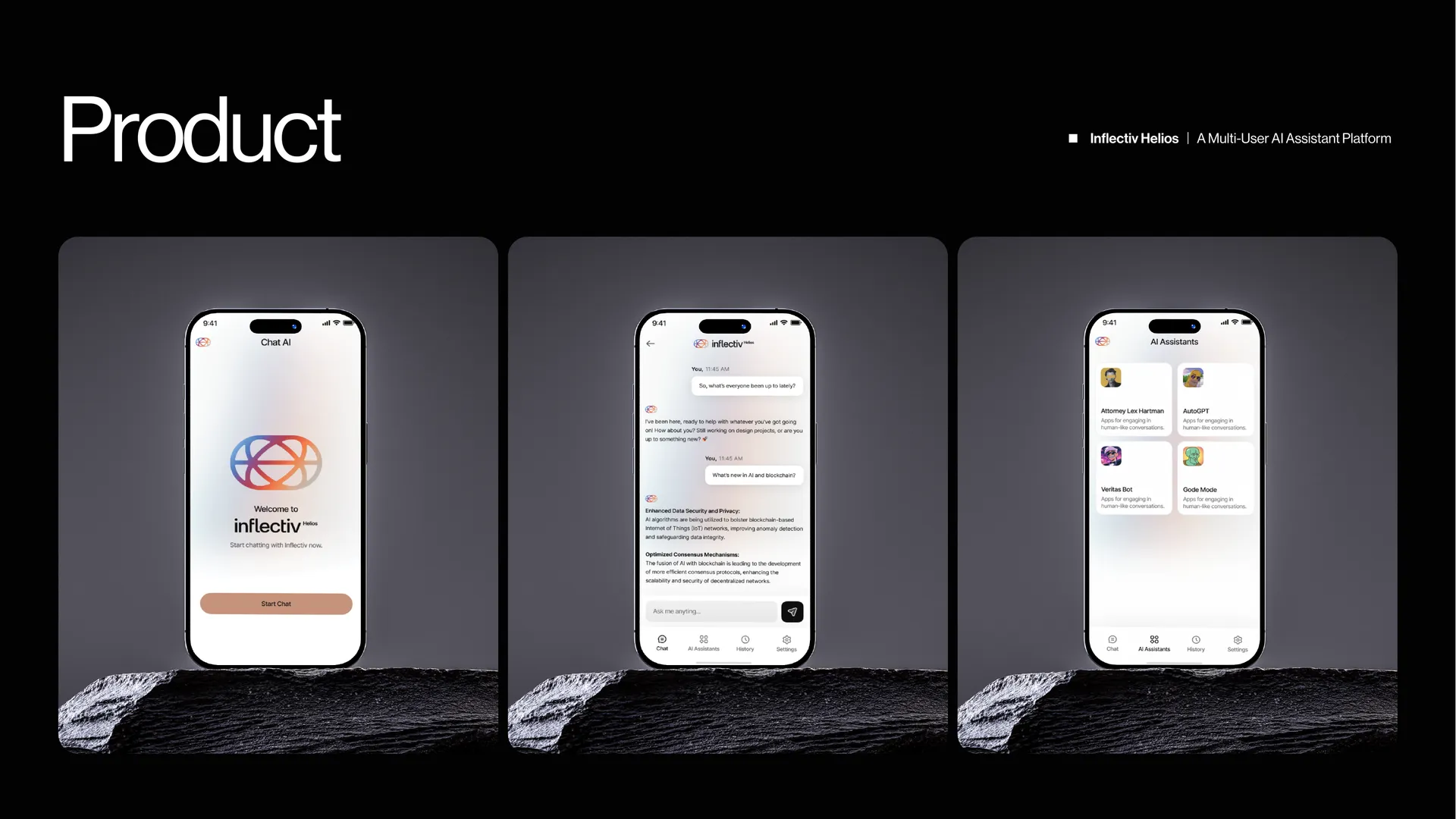
Inflectiv Helios — Multi-Assistant AI Platform
A multi-user AI assistant platform: specialized assistants per knowledge domain, conversational UI with history and personalization, Google Calendar/Meet integration, and full prompt observability — built to absorb new AI capabilities.
Every figure has a name behind it.
No rounded-up vanity metrics — each number below is tied to a specific, named engagement you can open and read.
Concrete, not conceptual.
Every engagement is scoped around artifacts you own from day one — reviewed weekly, yours to keep regardless of what comes next.
See how our rescue would work on your system.
The path to production.
Start to finish: 8–12 weeks.
Audit
One to two weeks: why it stalled, what's reusable, what the fix actually requires.
Rebuild the unglamorous 95%
Evals, guardrails, permissions, and integration into the systems where the workflow actually lives.
Production rollout
Phased rollout behind a human-review gate, instrumented from day one.
Baseline & handover
A measured report against the agreed metric, plus a runbook or ongoing operation.
How the stack orchestrates.
Chosen per engagement, never the other way around — this is how the pieces connect around the system we ship.
If the agreed metric isn't hit, the build's on us — you don't pay for it.
Asked on every first call.
The audit says so plainly, in week one or two, before the harder work begins — and we scope a rebuild instead. Either way you get a clear, honest answer faster than another quarter of quiet stalling.
We agree a single metric with you up front — tickets deflected, hours saved, cycle time. If the engagement doesn't move it, the build's on us: you don't pay for it. It only works because we insist on a measurable baseline from day one.
Every rescue is scoped individually once we've audited what you have — integration complexity and system count drive it more than anything else. The audit itself tells us, and you, the real shape of the work before either side commits further.
Most rescues convert into a managed AI operations retainer — monitoring, evals, and monthly accuracy reviews — once the system is live and the baseline is proven.
One call. Then a real answer.
- 30 minutes with a senior engineer, not a sales rep
- Free and no-obligation — bring your workflow or roadmap
- You leave knowing what's feasible and what we'd build first
- We reply within one business day
Three ways in. Pick by where you are.
You've got an AI pilot that stalled before production.
Let's put AI to work in your business.
A 30-minute call. You bring the workflow or the roadmap — we'll tell you what's feasible, what it costs, and what we'd build first.