
Agents that finish the job.
Agents that take work off your team's plate — in production, with guardrails, measured in hours saved.
Most AI agent demos die before production. Ours don't, because we engineer the unglamorous parts: permissioning, evaluation, fallbacks, observability, and the integrations into the systems where work actually happens — your CRM, ERP, ticketing, and internal tools. We scope agent projects around a workflow with a measurable cost, then automate it end-to-end.

Not a feature list. A Tuesday morning.
Here's what each of these actually looks like once it's running against your real workflows — not the pitch, the mechanism.
A simplified illustration of the mechanism — every real engagement is scoped to your workflow and measured against your own baseline, not this demo.
An illustrative feed — the shape of what a real deployment's ops log looks like, not live client data.
Support, ops, and sales copilots
A refund request lands at 11pm. The copilot reads the order, checks policy, issues it, and closes the ticket — resolved before your team clocks in, not summarized for them to finish.
Multi-step agent workflows with human-in-the-loop
A contract renewal touches legal, finance, and the account owner. The agent drafts the redline and routes each approval to the right person — and only interrupts a human when a clause falls outside policy.
Evaluation suites & guardrails before launch
Before the agent ever talks to a customer, it answers 500 real past tickets in a sandbox. Anything under the accuracy bar gets fixed there — not discovered by an angry customer in production.
Deep integration: CRM, ERP, ticketing, internal APIs
The agent doesn't live in a separate chat window bolted onto your stack — it reads and writes directly in Salesforce, SAP, or Zendesk, so the work actually leaves the queue instead of just getting summarized.
Our demo is the product.
Running right now, in this page. Give it something real — including something it should refuse — and see where its edges actually are.
A real call, not a recording. Press call once, then just talk — it hears you stop and answers. No buttons to hold.
This browser can’t capture speech — you can still type your side of the call. Chrome, Edge, or Safari for the full thing.
Live agents on fictional businesses and invented records. Nothing you say or paste here is recorded or stored — it lives in this tab and dies with it. A production deployment runs on your data, your systems, and your policy.
Shipped, not promised.
AI Support Agent for a DTC Ecommerce Brand
A production support agent handling order status, returns, and product questions across email and chat — integrated with Shopify and the brand's 3PL, with human escalation built in.
Cove — Home Security Platform Consolidation
Operator portal, headless CMS, and marketing platform for a US home-security device ecosystem — three disconnected systems consolidated into one operator experience.
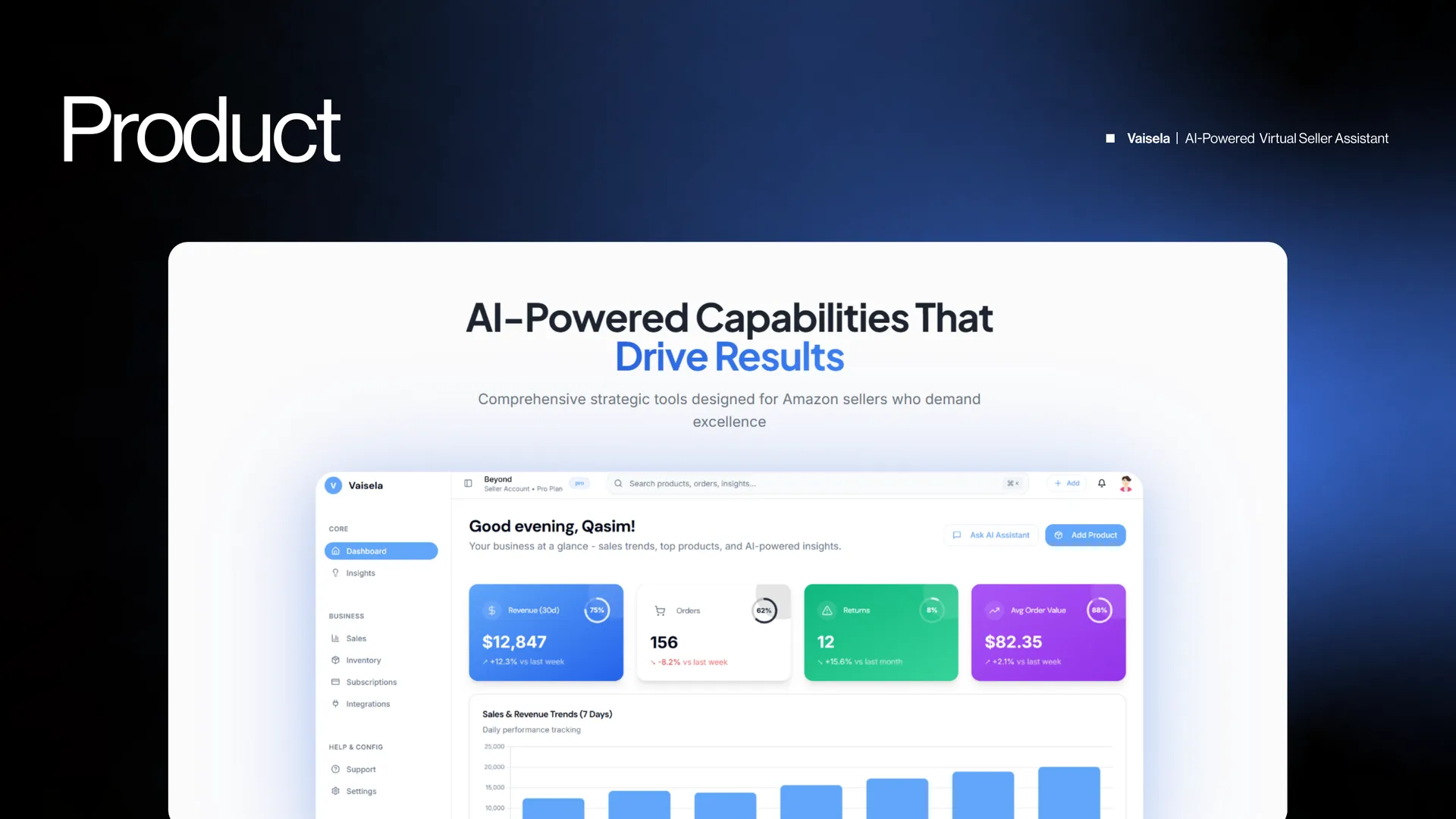
Vaisela — AI Virtual Seller Assistant for Amazon
An AI-powered virtual assistant for Amazon sellers: a custom-trained LLaMA model analyzes Seller Central data and proactively recommends actions — privacy-by-design, piloted with 200 sellers, architected to scale to millions.
Not hypothetical. Shipped, by vertical.
Only the industries where this exact capability has a real, running engagement behind it — not a generic list of who we'd like to work with.
Concrete, not conceptual.
Every engagement under this capability produces the same kind of artifact — reviewed weekly, owned by you from day one.
See what ai agents would look like in your stack.
The path to production.
Workflow audit
One week mapping the target workflow, its cost, failure modes, and the systems it touches.
Pilot agent
A scoped agent on real data behind a human-review gate, measured against baseline within 3–4 weeks.
Harden
Evaluation suites, guardrails, permissions, and escalation paths before any autonomous action.
Scale & operate
Production rollout with monitoring, cost controls, and monthly accuracy reviews.
How the stack orchestrates.
Chosen per engagement, never the other way around — this is how the pieces actually connect around the system we're building.
Asked on every first call.
Today's reliable wins: tier-1 customer support, order and claims processing, data entry and enrichment, internal knowledge lookup, meeting-to-CRM hygiene, and document-heavy back-office work. We qualify each candidate workflow by volume, error tolerance, and system access before proposing an agent.
Layered controls: scoped permissions (the agent can only touch approved systems), evaluation suites run before every release, confidence thresholds that route uncertain cases to humans, and full audit logs of every action. Autonomy is earned gradually, not granted on day one.
A measured pilot ships in 3–4 weeks. Production hardening and rollout typically takes another 4–8 weeks depending on integrations and compliance requirements.
Scoped to the workflow being automated, not a template — a narrow internal tool and a customer-facing agent across multiple systems price very differently. We anchor every proposal to a measurable baseline — hours saved, tickets deflected, cycle time reduced — so the cost is always tied to a number you can verify.
Yours. Agents run in your cloud (AWS, Azure, or GCP), with your data governance. We can also operate the system for you under a managed model.
Read the case for this.
A workflow-by-workflow reality check, from support tickets to back-office documents.
The real market ranges, from a $10k prototype to a $500k+ multi-agent system — and the run-rate line most budgets miss.
Let's put AI to work in your business.
A 30-minute call. You bring the workflow or the roadmap — we'll tell you what's feasible, what it costs, and what we'd build first.