
A white label software development partner. Your client never has to meet us.
A significant share of our work is delivered through other agencies, under their brand. You've sold work your bench can't staff and the start date is already promised — we put senior engineers inside your delivery, on your standups and in your repos, and your client never has to know we exist.
What is white label software development?
White label software development is an arrangement where one firm builds software that another firm delivers to its own client, under its own brand. The agency that sold the work keeps the client relationship, the contract and the credit; the engineers who actually build it stay behind that line and are never introduced as a separate vendor. It is how an agency takes on work its own bench cannot staff without turning the project down or missing the date it already promised.
In a Beyond Technologies white-label engagement that means senior engineers working inside your repositories, your standups and your tooling on your email domain, with no attribution on anything that reaches your client, your non-solicit and non-circumvention terms signed before anyone opens the repo, and all code and IP assigned to you on delivery.
Agency owners, principals and delivery leads who have sold work their bench can't staff — and need it built under their own name, on the date they already promised.
We work as a delivery partner to US agencies and product teams, and our engineers' work has shipped inside software used at major media and consumer-technology platforms. On your engagements, none of that shows up anywhere near your client.
Who this isn't for.
- ✕You want the cheapest hourly body-shop rate on the market — we're priced on senior output, not headcount.
- ✕You want to resell us as your own full-time employees to a client who has forbidden subcontracting.
- ✕You need someone on-site in your office five days a week.
- ✕You want us to own the client relationship and the commercials — that's your side of the line, permanently.
Sold work, unstaffed.
Four versions of the same week. If one of them is this week, the rest of this page is the answer.
You sold it. Now you have to staff it.
The SOW is signed, kickoff is in two weeks, and the two people who could have built it are booked through the quarter. Hiring takes months. We match from an existing bench, so the start date holds instead of the client call getting rescheduled.
The scope went AI and your team hasn't.
The client asked for an LLM feature, an agent, or a RAG layer, and the honest answer inside your team is that nobody has shipped one to production. Rather than learn on the client's budget, you bring in engineers who have — and your team learns alongside them, on your codebase.
Demand is lumpy and salaries are not.
Three projects land in March and one lands in July. Carrying full-time seniors through the trough is how agencies lose a year of margin. Capacity that scales up and back down protects the bench you already have.
You need a subcontractor who stays a subcontractor.
You've been burned, or you've heard the stories: the specialist who ends up on the client's Slack, then on their retainer. We work behind you by contract and by habit — no logo on the deliverable, no direct line to your client unless you put us on the call.
Will you go around us and take our client?
No — and the honest reason is commercial, not sentimental. One agency that trusts us sends work for years; one poached client ends that and every referral behind it. So we put it in writing: your non-solicit and non-circumvention clauses, signed before kickoff, for the term and after it. We don't contact your client outside the channels you set up, we don't market to them during or after the engagement, and if they approach us directly, we tell you and route it back to you.
- Non-solicit and non-circumvention signed before kickoff — yours, not our paper.
- No direct outreach to your client, during the engagement or after it.
- Inbound from your client comes straight back to you, in writing.
- Repeat agency relationships are the business model — protecting them is self-interest, not a favour.
Your brand. All the way down.
Not a promise to be discreet — a working arrangement, written into the contract and into the tooling before the first commit.
- 01Your brand on everything: your email domain, your Slack, your Jira or Linear, your repos, your CI.
- 02Your project manager runs the work. We report into your process, not around it.
- 03No Beyond Technologies logo, footer, or attribution on anything that reaches your client.
- 04Client-facing when you want it, invisible when you don't — introduced as your team, or not introduced at all.
- 05We sign your non-solicit and non-circumvention terms, and your NDA and DPA, before anyone opens the repo.
- 06All work product and IP assigns to you on delivery. You own the code, the prompts, the evals, and the docs.
- 07We publish nothing about your engagement or your client without written permission — several of our own case studies name no client for exactly this reason.
Send us the scope you've already sold.
Three shapes of subcontract capacity.
Pick by how much of the delivery risk you want to keep. All three run under your brand and your client relationship.
Dedicated AI Pod
A stable, senior cross-functional team — engineers, AI specialists, design, and a delivery lead — that owns outcomes on your roadmap quarter over quarter.
Managed Delivery
Fixed scope, fixed timeline, our delivery risk. Weekly demos, transparent metrics, and a single accountable lead from kickoff to production.
Staff Augmentation
Senior engineers and AI specialists embedded in your team, your process, your tools — vetted for the top of our 55-person bench.
What you can hand over.
The AI work agencies most often can't staff, plus the ordinary engineering underneath it — which is usually the larger half of the scope.
Eight years and 300+ delivered projects sit under the AI work. If you need a named individual rather than a delivery team, hire a specific engineer instead; if the capability is defined and the timeline is fixed, a scoped sprint may be the cleaner contract.
Shipped, not promised.
Direct clients, named — open them and read them. You won't find our agency work on this page: those clients belong to the agency, and their names were never ours to publish. That's the same reason your engagement won't appear here either.
Cove — Home Security Platform Consolidation
Operator portal, headless CMS, and marketing platform for a US home-security device ecosystem — three disconnected systems consolidated into one operator experience.
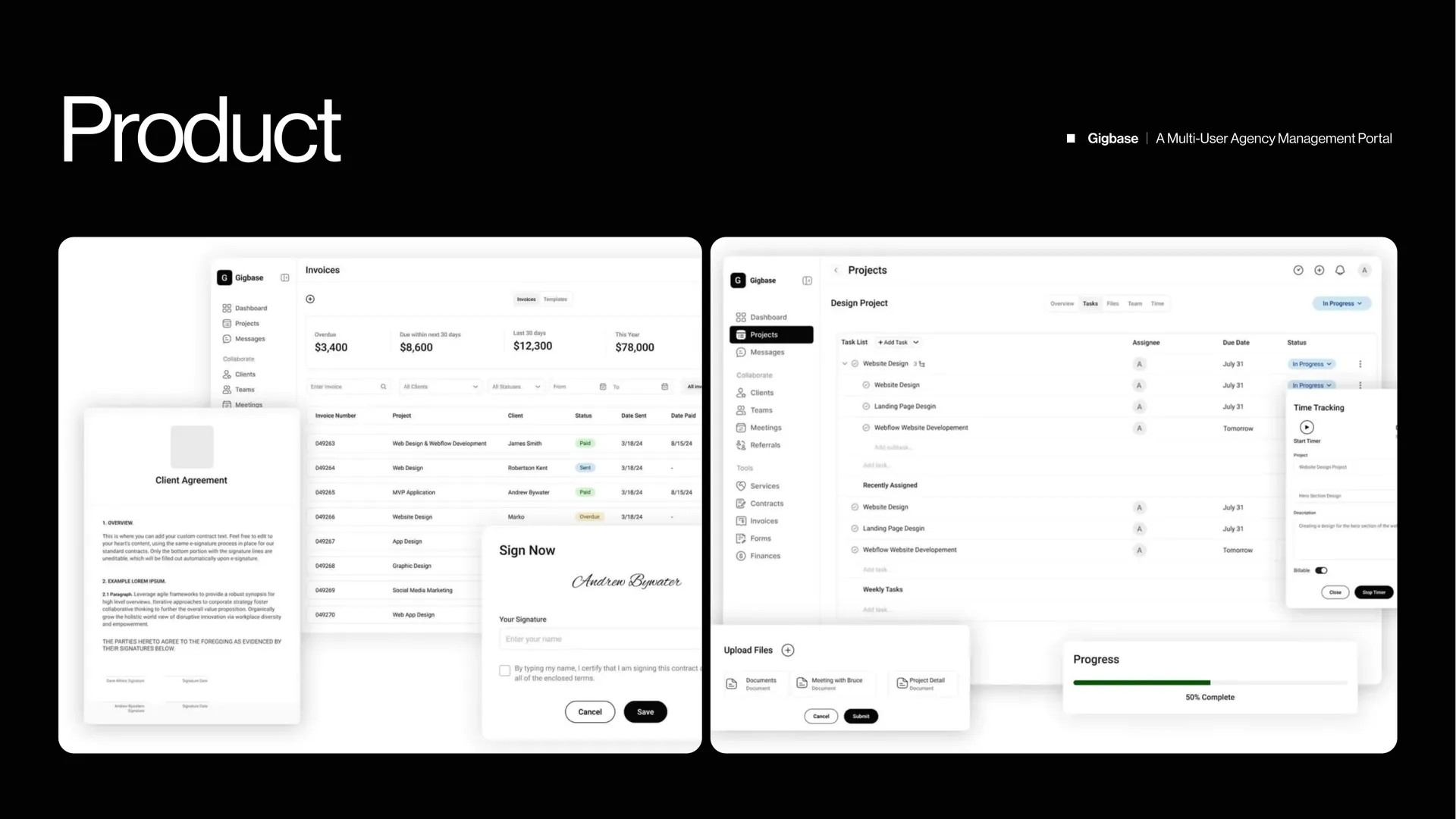
Gigbase — Multi-Tenant Agency Operating System
A multi-user agency management portal: projects, teams, clients, contracts, invoicing, real-time chat, meeting scheduling, and an admin-trained AI knowledge assistant — one subscription-based workspace.
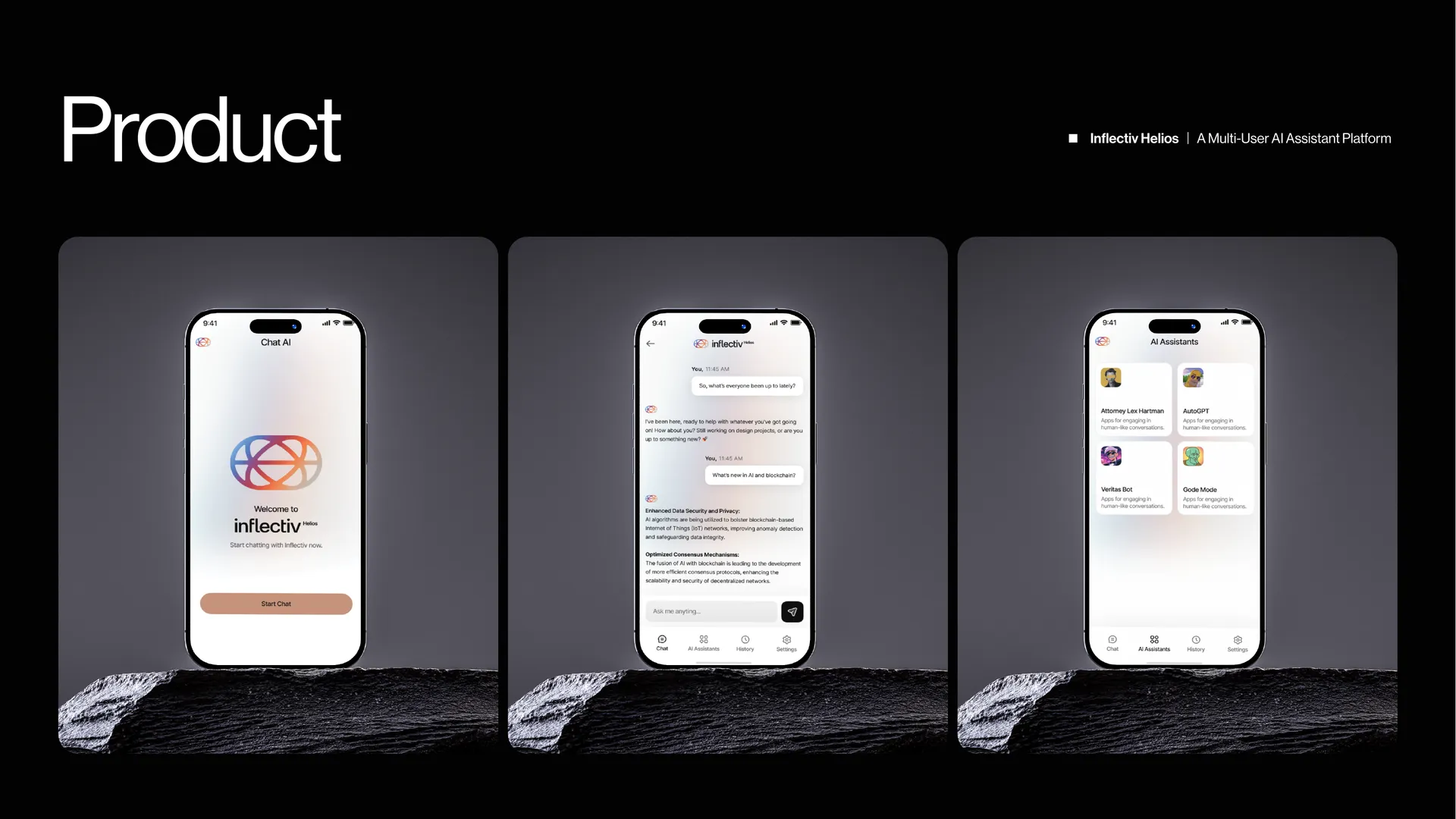
Inflectiv Helios — Multi-Assistant AI Platform
A multi-user AI assistant platform: specialized assistants per knowledge domain, conversational UI with history and personalization, Google Calendar/Meet integration, and full prompt observability — built to absorb new AI capabilities.
Signed first. Then keys.
Typically one to two weeks from the intro call to an engineer inside your repo — matched from an existing bench, not a cold hiring pipeline.
Scoping call
30 minutes with a senior engineer, under NDA if you want one first. You bring the SOW you've already sold; we tell you honestly whether we can hold the date.
Named engineers, not a pool
We propose one or two specific people for the work and you interview them the way you'd interview a hire. If neither is right, we say so rather than filling the seat.
Paper before repo access
Your NDA, your DPA, your non-solicit and non-circumvention clauses, and IP assignment — signed before anyone gets a key.
Trial week
A real first week of work inside your stack before any longer commitment, so the decision is made on output rather than a CV.
Embedded
Your standups, your tickets, your review process, your release cadence. Month-to-month after a short minimum, scaling up and back down with your pipeline.
Asked before anyone signs.
A white label software development agreement puts the subcontracted engineers behind the agency's brand and the agency's paper. In ours, the sequence is fixed: a scoping call against the SOW you have already sold, one or two named engineers you interview yourself, then your NDA, DPA, non-solicit, non-circumvention and IP assignment signed before anyone gets repository access, then a real first week of work before any longer commitment. After that the engineers run inside your process month-to-month, scaling up and back down with your pipeline.
No. We sign your non-solicit and non-circumvention terms before kickoff, we don't contact your client outside the channels you set up, and if they approach us directly we route it straight back to you. Commercially it isn't close: one agency relationship produces years of work, and taking one client ends it along with every referral behind it.
Disclosing a subcontractor is your call and your contract with your client — some agencies disclose, some don't, and we work either way. Our default is invisible: your email domain, your tools, no attribution on deliverables, and no introduction to your client unless you make it.
No. Agency engagements sit under the same non-disclosure we'd sign with you, and we don't go asking partners for permission to publish their clients — so that work stays off this site. What we can show you is our direct work, named and open to read, plus the named engineers you'll interview before you commit. Put it this way: if we were willing to publish another agency's client to win you, we'd publish yours to win the next one.
You do. All work product assigns to you on delivery — code, prompts, evaluation suites, infrastructure, documentation. It lives in your repositories from the first commit, not in ours, so there is nothing to hand over and nothing to hold.
Beyond Technologies is headquartered in Glen Allen, Virginia on US Eastern time, with engineering centers in Lahore and Dubai. Engagements run with US business-hours coverage — a US point of contact in your working day, and follow-the-sun progress overnight.
Yes, and you should. We propose one or two specific people for the work — not an anonymous pool — and you interview them the way you'd interview a hire. The first week is a real week of work before any longer commitment.
Every placement carries a two-week replacement guarantee, the same terms as our staff augmentation model. We'd rather swap early than have you explain a bad quarter to your client. Because the work lives in your repos and your documentation, a handover doesn't restart the project.
A white label engineer typically starts within one to two weeks of the intro call. We match from an existing bench of 55+ engineers and specialists, not from a cold hiring pipeline — which is the entire point when your start date is already sold.
Beyond Technologies does not publish a rate card for white label work. Subcontract capacity is priced day-rate or monthly against the seniority and hours the work actually needs, agreed in writing before anything starts, so you can price your own SOW with a fixed number underneath it. Tell us the scope and you'll have a real figure to margin against.
White label engagements run on a short minimum commitment and then month-to-month — the same terms as the rest of our staffing work. No tiers, no bundled subscription, no notice period designed to trap you.
AI agents, LLM and RAG applications, evaluation and observability work, plus the ordinary product engineering underneath it — web, mobile, APIs, data pipelines, cloud. Eight years and 300+ delivered projects sit behind the AI work, which is usually what an agency is actually buying: someone who can ship the boring 80% as well as the model.
Let's put AI to work in your business.
A 30-minute call. You bring the workflow or the roadmap — we'll tell you what's feasible, what it costs, and what we'd build first.