
AI data infrastructure services for the substrate nobody sees — until it breaks.
The data and cloud backbone your AI ambitions actually depend on.
Every AI initiative eventually hits the same wall: data that isn't ready and infrastructure that wasn't built for it. We build the substrate — ingestion pipelines, warehouses and lakehouses, vector infrastructure, Kubernetes platforms, and the CI/CD and observability that let AI systems run in production without surprises. Cost-engineered, because inference and data egress bills are real architecture constraints now.

Not a feature list. A Tuesday morning.
Here's what each of these actually looks like once it's running against your real workflows — not the pitch, the mechanism.
Data pipelines & warehouse/lakehouse builds
Reporting that used to mean a Slack message to an engineer becomes a dashboard anyone on the team can query themselves — because the pipeline behind it runs on a schedule, not a favor.
Vector & retrieval infrastructure at scale
The RAG demo that worked great on 50 documents gets infrastructure that still answers correctly at 2 million — because retrieval at scale is an infrastructure problem, not a prompt-tuning one.
Kubernetes platforms, IaC, zero-trust networking
A new service ships behind the same access controls as everything else in the cluster — nobody approves a firewall rule by hand at 2am, because the policy is already code.
MLOps: deployment, monitoring, cost control
The model that quietly got more expensive to run last month gets caught by a cost dashboard in the weekly review — not by finance asking why the cloud bill jumped.
Our demo is the product.
Running right now, in this page. Give it something real — including something it should refuse — and see where its edges actually are.
A real agent, not a screenshot. Give it something to work on and watch what it does — including what it refuses to guess at.
Live agents on fictional businesses and invented records. Nothing you say or paste here is recorded or stored — it lives in this tab and dies with it. A production deployment runs on your data, your systems, and your policy.
Shipped, not promised.
Concordia Colleges — 150-Branch SIS Platform
A complete Student Information System for a network of 150+ college branches: revenue and royalty management, fees, LMS, student and teacher operations, payroll, and accounts — unified on one platform.
Cove — Home Security Platform Consolidation
Operator portal, headless CMS, and marketing platform for a US home-security device ecosystem — three disconnected systems consolidated into one operator experience.
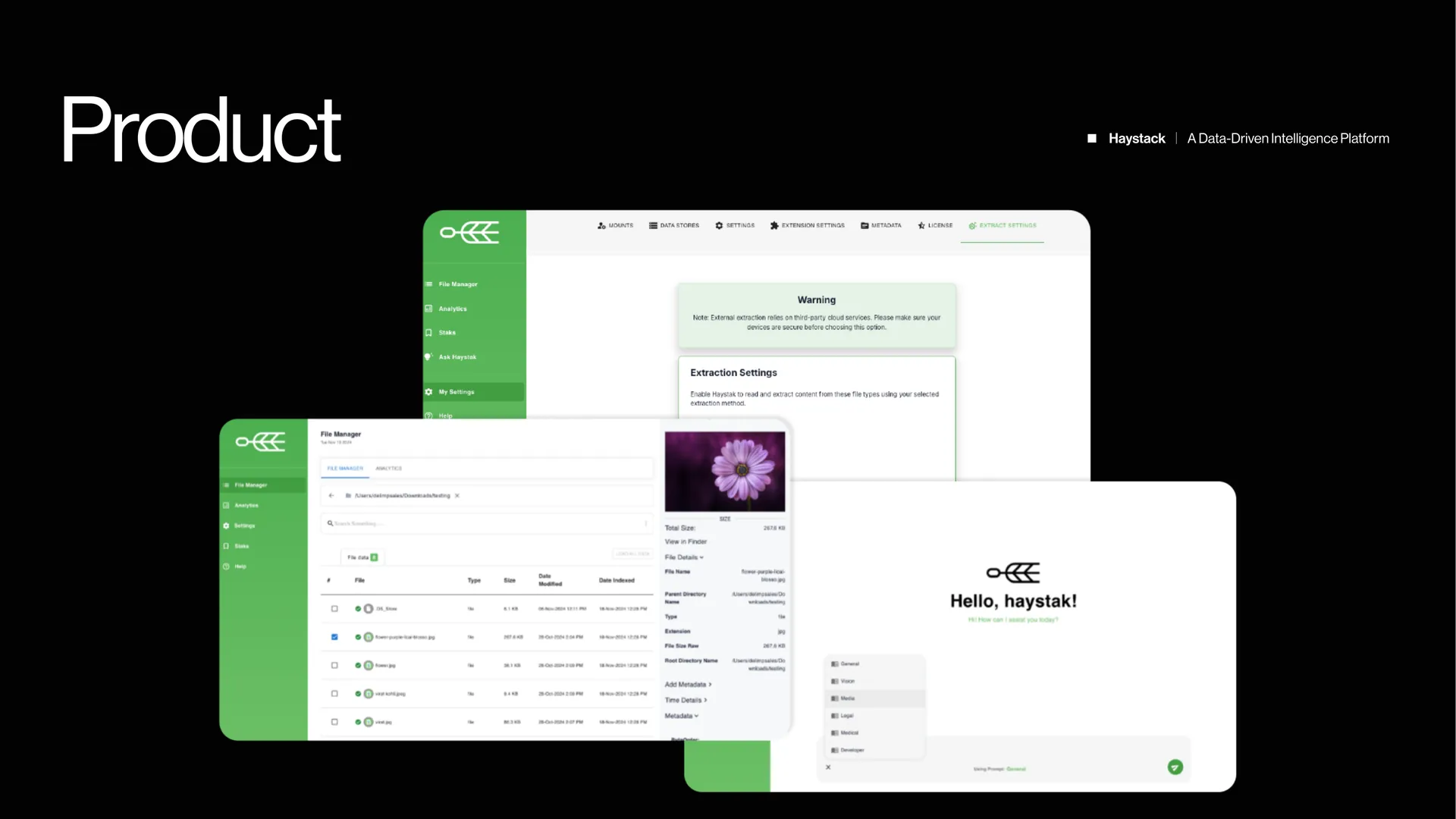
Haystack — AI Data Intelligence Platform
A data-driven intelligence platform: one AI search layer across documents, data lakes, and repositories, with real-time indexing, AI-driven correlation, and workflow automation — built to hold up under heavy data loads.
Beyond Technologies ensured a streamlined workflow with consistent project updates throughout — the platform now runs our entire network.
Not hypothetical. Shipped, by vertical.
Only the industries where this exact capability has a real, running engagement behind it — not a generic list of who we'd like to work with.
Concrete, not conceptual.
Every engagement under this capability produces the same kind of artifact — reviewed weekly, owned by you from day one.
See what data & cloud would look like in your stack.
The path to production.
Audit
Current-state review of data, infra, cost, and security against your AI and product roadmap.
Design
Target architecture with explicit cost model and migration sequence.
Build
IaC-first rollout in incremental waves — no big-bang migrations.
Operate
SLOs, on-call options, continuous cost tuning, quarterly architecture reviews.
How the stack orchestrates.
Chosen per engagement, never the other way around — this is how the pieces actually connect around the system we're building.
Asked on every first call.
AWS, Azure, and GCP, plus hybrid and on-prem where compliance requires it. We're pragmatic about multi-cloud: portability where it matters, no unnecessary abstraction tax where it doesn't.
Your data is ingestible, quality-monitored, retrievable (including vector search where relevant), access-controlled, and cheap enough to query at production volume. We assess against those five properties and close the gaps in priority order.
Usually 20–40% on unoptimized estates. Cost review is built into every infrastructure engagement — rightsizing, storage tiering, egress design, and inference cost modeling for AI workloads.
Let's put AI to work in your business.
A 30-minute call. You bring the workflow or the roadmap — we'll tell you what's feasible, what it costs, and what we'd build first.