
AI product design services that make trust visible.
Interfaces that make AI feel dependable — and complex products feel simple.
AI products fail in the interface as often as in the model: users don't trust what they can't predict. Our design studio pairs classical product design craft — research, information architecture, design systems — with the new patterns AI demands: progressive trust, visible reasoning, graceful uncertainty, and human handoff. Every artifact ships production-ready, straight into our engineering pods or yours.
Not a feature list. A Tuesday morning.
Here's what each of these actually looks like once it's running against your real workflows — not the pitch, the mechanism.
UX research & product discovery
Before a single screen gets designed, a handful of user interviews reveal that the feature everyone assumed was the priority isn't what's actually blocking adoption.
AI interaction patterns: trust, uncertainty, handoff
When the AI isn't sure, the interface says so and offers a clear way to hand off to a human — instead of confidently returning a wrong answer that erodes trust in everything it does next.
Design systems engineered for handoff
A component built once in Figma ships to engineering with tokens, states, and spacing already defined — so 'that's not what I designed' never gets said in a sprint review again.
Prototyping & usability validation
Before a quarter of engineering time gets committed, real users try the interactive prototype — and the confusing step gets fixed while it still costs an afternoon, not a rebuild.
Our demo is the product.
Running right now, in this page. Give it something real — including something it should refuse — and see where its edges actually are.
A real agent, not a screenshot. Give it something to work on and watch what it does — including what it refuses to guess at.
Live agents on fictional businesses and invented records. Nothing you say or paste here is recorded or stored — it lives in this tab and dies with it. A production deployment runs on your data, your systems, and your policy.
Shipped, not promised.
Generative Catalog Intelligence for a Marketplace
A generative enrichment pipeline turning inconsistent seller listings into structured, search-optimized product data — descriptions, attributes, and categorization at catalog scale.
Government of Punjab — Province-Wide Teacher Training
An interactive early-childhood teacher training program delivered as an offline-first mobile application — deployed province-wide on low-end devices with intermittent connectivity.
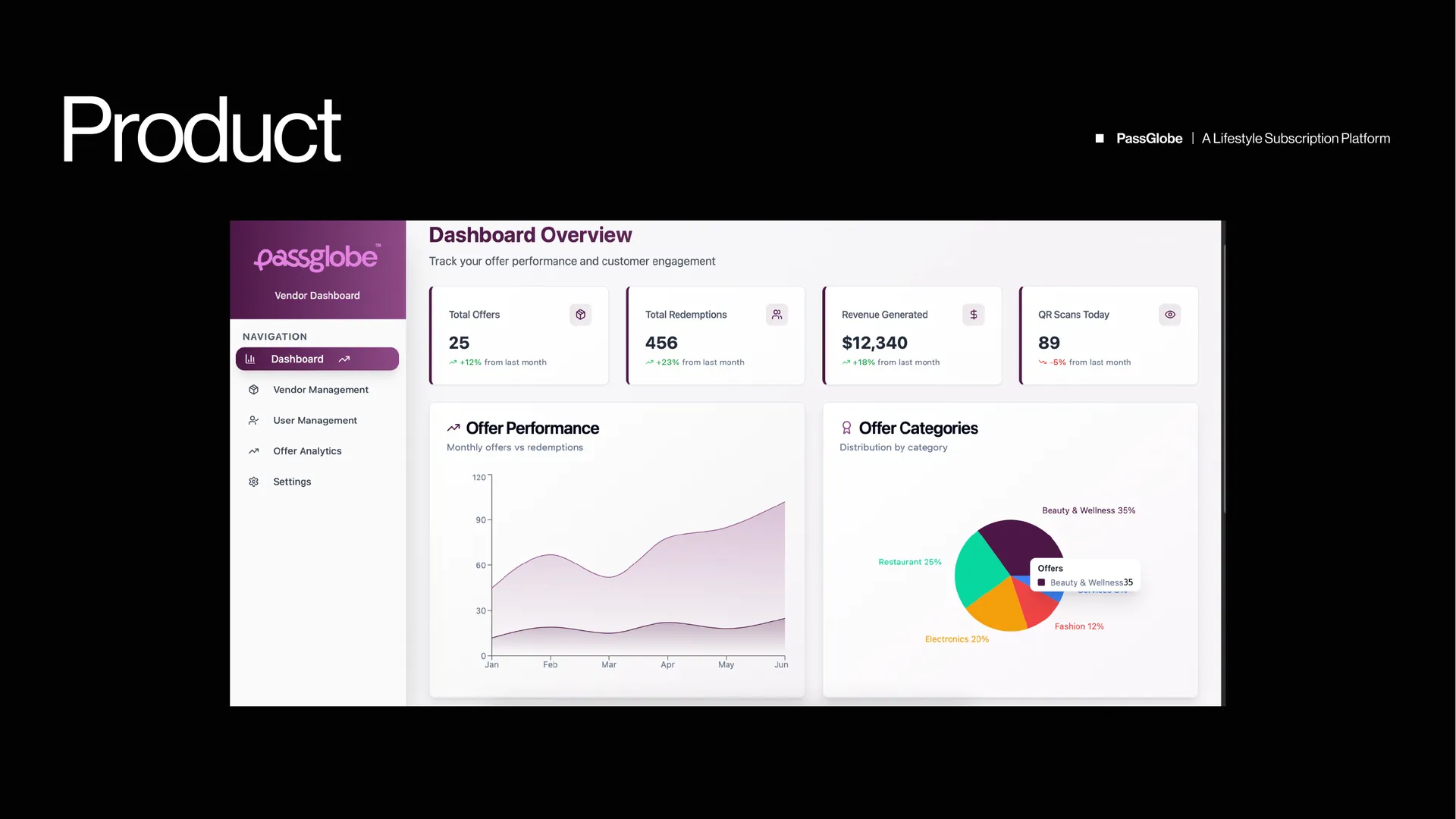
PassGlobe — Lifestyle Subscription Platform
A subscription-driven offers ecosystem built around three dashboards — user, vendor, admin — plus a conversion-focused marketing site. Weekly Stripe subscriptions, QR-based one-time redemptions, launched in Azerbaijan and built to expand globally.
Not hypothetical. Shipped, by vertical.
Only the industries where this exact capability has a real, running engagement behind it — not a generic list of who we'd like to work with.
Concrete, not conceptual.
Every engagement under this capability produces the same kind of artifact — reviewed weekly, owned by you from day one.
See what design would look like in your stack.
The path to production.
Research
Stakeholder and user interviews, analytics review, competitive teardown.
Structure
IA, task flows, and wireframes — agreement on bones before pixels.
Craft
Visual system, components, and AI interaction patterns in hi-fi.
Validate
Prototype testing with real users before engineering commits.
How the stack orchestrates.
Chosen per engagement, never the other way around — this is how the pieces actually connect around the system we're building.
Asked on every first call.
Uncertainty is part of the product. Good AI UX makes confidence visible, failure graceful, and human override obvious — while keeping the interface calm. We've developed tested patterns for copilots, agent supervision, and AI-assisted workflows.
Yes — a two-week UX audit delivers a prioritized findings report and a roadmap. It's a common starting point before a larger design or engineering engagement.
Either. Our design systems ship tokenized and documented for any competent team — but most clients pair design with one of our engineering pods so nothing is lost in translation.
Let's put AI to work in your business.
A 30-minute call. You bring the workflow or the roadmap — we'll tell you what's feasible, what it costs, and what we'd build first.