
The layer that can't afford to be slow.
Golang services for the highest-throughput layer of a data or AI platform — indexing, search, and correlation across large datasets, engineered to hold up under real production load, not a demo dataset.
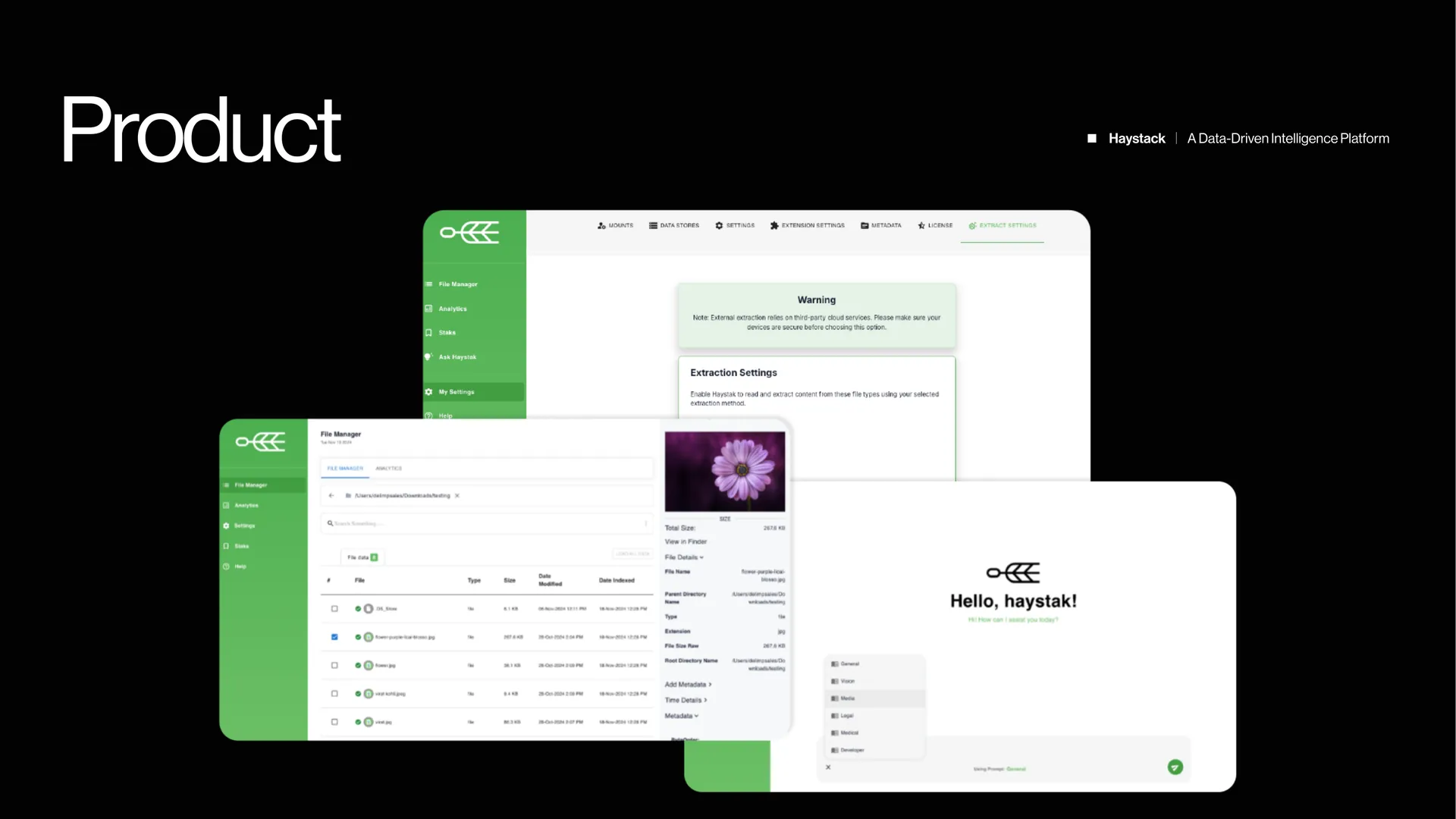
We reach for Golang for one specific job: the part of a system where throughput and concurrency matter more than anything else — indexing pipelines, search infrastructure, and correlation engines that have to process data continuously rather than in a request/response cycle. Haystack's data-intelligence platform is the clearest example: a unified AI search layer across documents, data lakes, and repositories that has to stay real-time as new data lands, on a system that had already failed under high data loads on its previous stack. Golang handles the high-performance indexing and search underneath; Next.js and NestJS handle the parts of the product that don't need that discipline.
Not a feature list. A real workflow.
Here's what this actually looks like once it's running against your product — not the pitch, the mechanism.
Concurrency without a request queue backing up
Real-time indexing means data keeps arriving while a search or correlation job is still running. Go's goroutines let us process concurrently without the thread-pool exhaustion that sinks a naively-built service under load — the exact failure mode the system it replaced had already hit.
A correlation engine that doesn't fall over on structured and unstructured data together
Finding patterns across a mix of documents, structured records, and data-lake entries means running different extraction paths in parallel and reconciling them. We build that as a set of independently-scalable Go services, not one monolith that degrades everywhere at once when one data type spikes.
A service that gets simpler to operate, not just faster to run
Go's static binaries and low memory footprint mean deployment and scaling stay simple as load grows — one less operational surface to firefight when the rest of the product is already asking for attention.
Concrete, not conceptual.
Every engagement under this stack produces the same kind of artifact — reviewed weekly, owned by you from day one.
See what Go would look like on your AI system.
How Go orchestrates.
Chosen per engagement, never the other way around — this is how the pieces actually connect around the system we're building.
Asked on every first call.
Concurrency model. Node.js is excellent for I/O-bound orchestration — webhooks, API calls, queues — but a CPU- and throughput-bound job like continuous indexing across large datasets runs more predictably on Go's goroutines than on Node's single-threaded event loop. We use each where it's actually the better tool, not by default.
Just this layer, deliberately. Haystack's platform pairs Go for indexing and search with Next.js and NestJS for the product surface and API layer — the parts where Go's throughput advantage doesn't matter but its smaller ecosystem for UI and rapid API iteration would slow us down.
We load-test against a realistic approximation of your actual data and traffic pattern before launch, not a synthetic benchmark — the same discipline that let Haystack's search layer replace a system that had already failed under high data loads.
Let's put AI to work in your business.
A 30-minute call. You bring the workflow or the roadmap — we'll tell you what's feasible, what it costs, and what we'd build first.