
Built for the network you actually have, not the one in the demo.
React Native apps engineered for the constraints real users hit — intermittent connectivity, low-end devices, and a mobile experience that matches a web AI platform's capability instead of trailing it.
We're a React Native team for one specific kind of mobile app: one that has to work when the network doesn't. That's the difference between a demo that works on a test device over office wifi and an app that holds up at province-wide scale, on low-end Android hardware, with connectivity that comes and goes — the exact problem behind the Government of Punjab's offline-first teacher-training platform. The same discipline carries over when the mobile app is the companion to a web AI product rather than the whole product: Inflectiv Helios's multi-assistant platform ships the same conversational core to both Next.js on the web and React Native on mobile, so a user switches devices without switching experience.
Not a feature list. A real workflow.
Here's what this actually looks like once it's running against your product — not the pitch, the mechanism.
Offline-first, not offline-tolerant
Most apps treat a lost connection as an error state. We architect local-first: content and progress sync when a connection exists and queue safely when it doesn't — the pattern behind a training curriculum used on low-end devices with intermittent service, province-wide.
One conversational core, two platforms
When an AI product ships to web and mobile at once, the assistant's state, history, and personalization can't diverge between them. We share the service layer and keep only the rendering native — Inflectiv Helios's assistants behave identically whether a user opens the Next.js web app or the React Native mobile app.
Built for the device your users actually own
A flagship-phone demo hides real problems: memory pressure, slow storage, older OS versions. We test and profile against the low end of the target device range from week one, not after a beta complaint.
Shipped, not promised.
Government of Punjab — Province-Wide Teacher Training
An interactive early-childhood teacher training program delivered as an offline-first mobile application — deployed province-wide on low-end devices with intermittent connectivity.
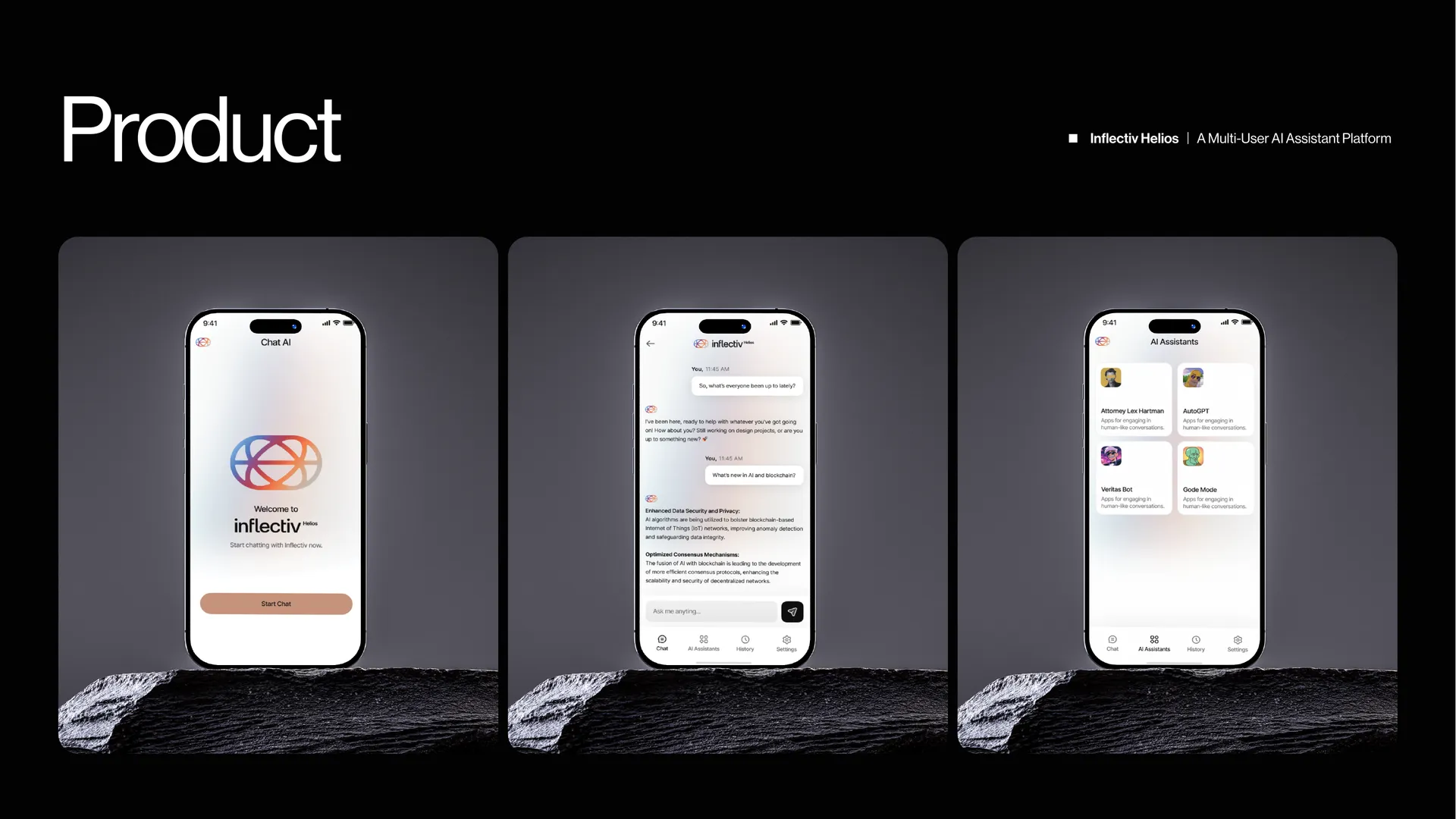
Inflectiv Helios — Multi-Assistant AI Platform
A multi-user AI assistant platform: specialized assistants per knowledge domain, conversational UI with history and personalization, Google Calendar/Meet integration, and full prompt observability — built to absorb new AI capabilities.
Concrete, not conceptual.
Every engagement under this stack produces the same kind of artifact — reviewed weekly, owned by you from day one.
See what React Native would look like on your AI system.
How React Native orchestrates.
Chosen per engagement, never the other way around — this is how the pieces actually connect around the system we're building.
Asked on every first call.
Whichever the app actually needs — a managed workflow when it doesn't need custom native modules, bare React Native when it does (native SDKs, background sync, hardware access). We decide based on the constraints, not a default.
Yes — the API/service layer, business logic, and data models are usually platform-agnostic and can be shared or mirrored between a Next.js web client and a React Native mobile client, the way Inflectiv Helios's assistants share state across both. Only the rendering layer stays native.
Design for the low end of the target device range and the worst realistic connection from day one — local-first data with explicit sync/conflict rules, aggressive asset optimization, and load testing against real low-end devices rather than a developer's own phone. That discipline is what let a province-wide teacher-training rollout hold up on intermittent connectivity rather than degrade under it.
Let's put AI to work in your business.
A 30-minute call. You bring the workflow or the roadmap — we'll tell you what's feasible, what it costs, and what we'd build first.